This year the BREWT peer conference – the third one already! – moved location. We traded the old location in for a former brewery where we welcomed sixteen people from six different countries. We were set to discuss four widely varying topics during the day. After a warm welcome by our head of ceremony Beren we were off to a good start.
Cindy – a homegrown local Belgian tester – kicked off with the first topic of the day. She explained how she ended up being the sole tester on two entirely different teams: she started on the refactoring team where she was the only one responsible for testing. When the legacy team lost their tester she was added to that team. This lead to the difficult situation where she’s constantly asked to switch context which leads her to feel like she isn’t doing her job well enough for either team. The group rushed to get more insight into how the teams were structured and offered great advise on how Cindy could begin to tackle the problems she is encountering.
After a quick break Joep presented his mind map on “Developing isn’t hard but it is a lot”. We were shown the mind map he made while trying to create a small plugin for pytest (which he was working at for his teams). It contained everything you needed to know or be aware of while developing something minor.
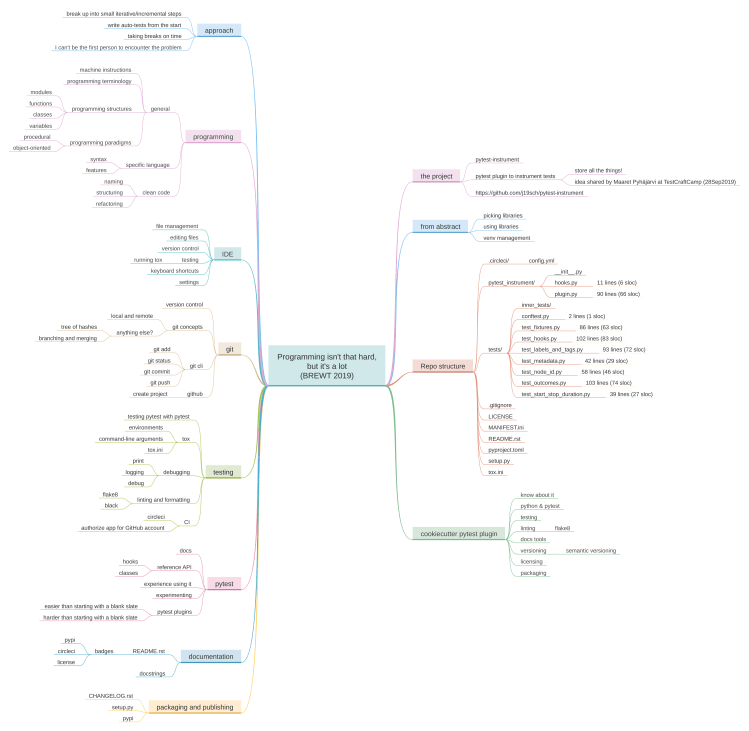
This mind map contains a lot of topics with the majority of them not strictly related to coding… which is exactly the point he set out to make: programming isn’t hard, but it is a lot. As a group we found a lot of value in the mind map as a layout for starting coders, tips for novice developers on what areas to focus on in their learning, as a signal to aspiring coders that it can be overwhelming (and that we are aware), etc.
Before we went to lunch Patrick told his tale of two teams. He described a situation at his client’s where there was one giant team that was split up and now he is in charge of two of those teams. He believes he gave both teams the same opportunities and information, but the results in maturity were very different: why would that be and what were (new) possibilities given that context? This is where we stopped for a well deserved lunch with excellent soup and delicious sandwiches.
After lunch we continued with the debate about the two teams: how they performed and how their needs could differ so much. They were given the same guidance to form the team how they wanted and this lead to widely different teams. We explored – together with Patrick – where these differences might originate and what tactics could prove successful in getting both teams to the same place.
We ended the evening with Antonella opening up her brain for us. This deeply personal story explained how she had felt the last year. She explained how her employer made her feel, how she quit her job and especially at the steps she took to improve her own life over time and where she is now.
Her brain was presented to us as a ball of string, which she literally unraveled before our very eyes. While doing this, there were different topics attached, which were all deeply personal. This brave display opened the group for a warm discussion about mental health.
This amazing day of learning came to an end with the tasting of some local beers and a good dinner. Andreas guided us through Ghent city by night and we concluded BREWT 3 with a last shared drink.
Thank you to all participants for sharing your stories, insights and ideas! It feels like the best BREWT conference so far and we hope to welcome you and others next year.

Participants:
Patrick Van Enkhuijzen (BE)
Joris Meerts (NL)
Gwen Diagram (UK)
Ash Winter (UK)
Yannick Clybouw (BE)
Del Dewar (SCOT)
Cindy Tomme (BE)
Maja Hołyńska (PL)
Marijke van Imschoot (BE)
Andreas Faes (BE)
Beren van Daele (BE)
Geert Van De Lisdonk (BE)
Antonella Scaravilli (AR)
Elizabeth Zagroba (US)
Joep Schuurkens (NL)
Vernon Richards (UK)
 BREWT
BREWT 